A kind heart is a rebellious heart because she doesn’t fit in.
We often hear that God’s denial of our desires is simply a redirection, and as cliché as it may sound, it is the truth. God does not deny us something we want; He simply keeps a door closed because He knows – He has seen things we cannot see, heard words we cannot possibly hear, and He knows not only what our hearts desire, but also our potential and what we deserve. If someone has disappointed you or treated you badly (whether at work or in your personal life), stop knocking on the same door. They have already shown you their face; they have already shown you who they are. The world does not end with a failure, or with a disappointment, or a setback. What matters is to remain friends with God and to be at peace with yourself, with your conscience. What seems like failure may be God’s plan to protect you or to shape you, in order to welcome His final plan for you. That is why in the end, the one who initially seems lost is the one who gets it all…because he does not even make discounts in his dreams, and sleeps with his conscience at ease, having won the greatest gift: the love of God!
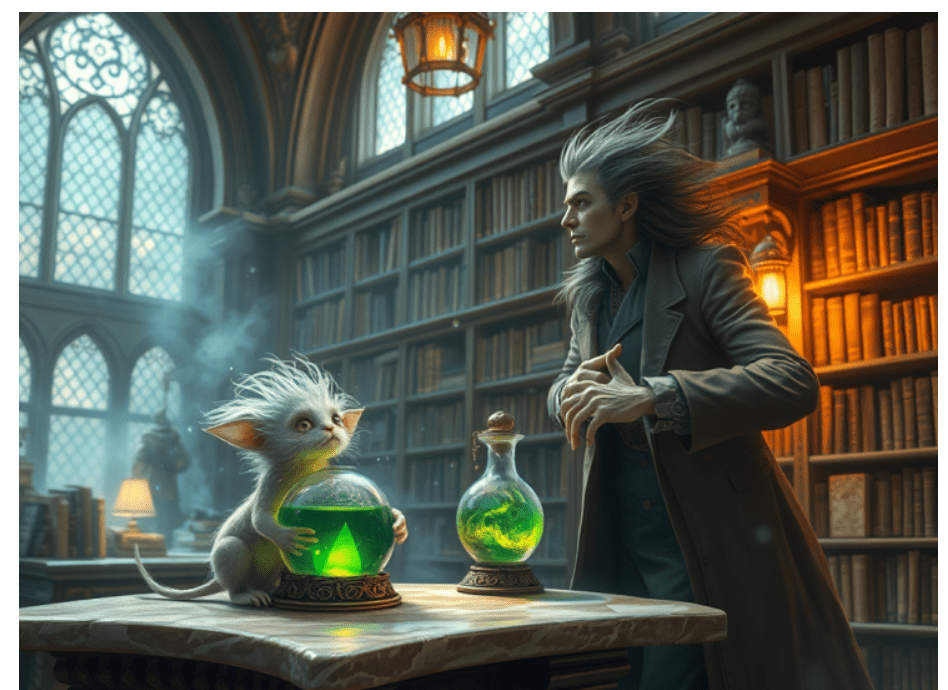
A sharp voice was heard from the depths of the corridor and before he could respond, Tzoulis, the tall, hurried man, passed by him like a tornado, disrupting the order in which the attendance sheets had been arranged in the section of the library that had not yet been repaired and would host for a while the creatures that had not yet found their destination – regardless of the kingdom they belonged to. “Good morning to you too, sir!” replied the tiny, tender creature who allowed himself to steal a few grains of time from the tasks he had to supervise and take a quick look at Psychoilos.
“Shall I have you prepared some of the special purple tonic herb, sir?”, added the tired creature, standing next to him, arranging his sparse white hair that was torn in front of his forehead, restraining himself from the temptation to drink the specific time scroll for the third time – far above the limit carved on the tree with the contraindications, right above the infirmary.
“Mmm, purple … no, not purple … it makes me cautious, better green. Yes! that’s it, green! for some reason it makes me more optimistic and I don’t have to avoid the odd number of stones on the city sidewalks and today I don’t have a single grain of sand to waste!
“green is it, GREEN is it!” the assistants jumped from behind the large marble kitchen counter and immediately emptied the filters they had prepared until then, into the wooden garbage chute.
“wink – wink!”, was heard from the depths of the floor that had no doors to the rooms, like some polite French gesture, as the first peacocks vacated their seats, delighted by the warm pomegranate milk they had successfully prepared and could move on to the lessons of the next hourglass.
“Get it, Jules! I don’t know what they want from me anymore! I’m not an expert in kite making and yet this is the only and continuous order I have. I do nothing more than measure their angles and add the materials according to their wishes. But how is it possible that I’m lucky in this, when what I’ve always wanted is to carve statues, I wanted it so much that I was convinced that I saw signs on the paths in the forest of the Centaurs. They have the answers! They! They can’t have played with me … and yet …”
“I know how you feel sir, you can’t even see the green broth I’ve prepared for you, because as we speak it has become transparent …”
“It’s as if I didn’t choose, but the call came to me”
“Do not be discouraged,” replied the creature with deep yellow, expressive eyes, “the delay does not mean that you have been denied the right to retrace the path of the Centaurs. Perhaps it is a matter of faith, sir – when does one become sure of one’s faith, in difficult times!”, he added and offered him a new mixture of broth.
“My dear Julius!”, replied the Psychoelos with a look of gratitude and opened his fist for the little creature to climb. “If it weren’t for you, this place would have collapsed and now we’re accepting new apprenticeship applications!” Jules slipped, thus finding his way back to the gallery at the root of the oldest tree and smiled, slightly pleased with himself. He turned back for a moment and threw a few words into the air:
“Intention determines its outcome, not the materials, at least in our world…” and this time he disappeared into the impassable space of the marble chamber, skipping a few more steps…
There is a place sheltered from the wind A place like purgatory Where friends gather To wash their wounds A fire like a sting, glows in their place And then they begin to walk Outside the city with its high walls ~ From such a place I come too…
They gathered around a fire and exchanged stories.
One was a Sentinel resting from a long journey in the desert. In the middle of nowhere, he waited for what he had lost. Something that never came. He was tired of the winds, so he decided to stay still and steadfast. A blind imprisoned monk and the Sentinel crossed paths. Outside a carriage, he was thrown, and the blind man fell right in front of the guard’s knees. He could not see, but he felt a presence, a light. Like fireflies, glowing dots led him to the hand of the guard. He continued to hold the hand of the guard, whose air surrounding him smelled of gardenias and seas. When their eyes reached the same height, the monk went to let go of his hand. And then he felt a tightness in the heart. As if someone had put his hands inside and was holding it hanging. He felt the thorn that the guard had for so long in his hand. Only a blind person could see it, and feel it. Because to feel it meant it entered the eyes of his soul. The blind man didn’t know how to take it off but couldn’t leave the other man behind. Months, years, winds, storms, everything was left in shambles. Just before the blind man died, he took a knife and cut off their hands that were joined, as they had been prisoners for all this time. He fell back, hitting his back. The thorn also fell. The guard smiled at the rose coming out of the thorn. And the blind man searched with his touch for his severed hand that freed him from the prison.
So what if he couldn’t play music again? He could now freely sing …
You were beautiful, even though you didn’t let the gaze penetrate your soul … you were afraid of your truth, you were afraid they would find it ugly and without shape … all my life, every word (will) imply how beautiful you were … and this is a correction and a rearrangement of fate ^
She heard the winds calling her and stepped onto the stone balcony. It was as if she longed to summon a storm, yet her face remained composed. Without looking back, she closed the windows behind her. Her eyes fixed only on the lake ahead. She wore her red cloak.
Dozens of birds swept past the balcony, vanishing into the winds beyond. None settled on the stone floor. They brushed against her hair and cloak as they flew, black wings grazing the red fabric, her pale face as still as the stones beneath her feet. She stood listening as the rustling leaves played a strange melody, as though summoning something. She waited.
When the sun disappeared, the world fell silent. They called it a cursed sign. Still, spring did not come.
Then the black bird returned — the one they had cast out — and from its mouth it dropped an emerald gem onto the windowsill. Its beak was a pinkish-beige, the color of flesh.
The woman in the red cloak moved toward the gem, her eyes never leaving the bird. It held the emerald in its beak until she took it. She reached out and stroked its tail feathers. The bird hopped into her hand, then climbed to her chest and nestled into her arms, tilting its head so it rested perfectly against her shoulder. Its small dark eyes, almost human, looked into hers. She smiled.
But the black bird rose suddenly toward her neck. It might have kissed her — but no. Staring into her eyes, it tore her throat open. Blood poured out, staining the cloak until the fabric seemed to grow out of the wound itself.
She gasped, clutching at the clouds above as pain consumed her. Yet instead of screaming, she kissed the black bird. Butterflies burst from her wound as the bird’s eyes widened. With trembling hands, she lifted the emerald and sliced the wound wider, and the bird began to grow white wings around its beak.
An explosion split the sky, and the sun returned. The black bird became pure light and vanished. She turned back to the stone house only to whisper goodbye.
Then she walked to the lake and slipped off her red cloak. She was not cold. She felt no shame. The trees stood guard as she smiled at the winds that had already forgotten her.
She stepped into the water and vanished beneath its circling depths.
It’s born from combining Sacrifice + Satisfaction. The word describes the choices we make when pursuing a goal — seeking the minimum sacrifice needed to reach an acceptable level of satisfaction.
Perhaps this etymology sounds a little technical, but in an age when technology is deeply embedded in our lives — so much so that we can barely remember a world without smartphones and hyper-intelligent search engines — it’s a concept worth keeping on the speed dial of our smarter-than-life devices.
This idea may provoke some pivotal thinking.
A state of total surveillance may sound far-fetched at the moment. But are we really in a position to act stoically about it? Are we sure we’re at a safe distance from such a reality?
Imagine a near future where citizens of democratic republics are reduced to numbers — social security IDs tied to a monthly “social score,” ranked from zero to ten, from “threat” to “obedient.” The last time humans became numbers among numbers was in the concentration camps of World War II, where data was also collected, tracking who was efficient enough for ongoing projects.
In an era of fast fashion, fast food, and fast love, can we afford to make fast decisions based exclusively on data?
Can we trust AI — machines of artificial intelligence — to make decisions for our future without considering ethos, empathy, and morals? Can a machine learn to care for its creator, or would it turn against its “father” if the incoming data suggested it was for the greater good? Would you accept a decision that’s perfectly legal but morally unclear?
This might sound dystopian or futuristic, but it’s already happening on a smaller scale. Many people eagerly share their facial features on apps, chasing the thrill of belonging to social media culture — unaware that our digital traces never truly disappear, even if we delete our accounts.
At the peak of technological convenience, data has become the most valuable resource. Data brokers now claim that selling data will soon be more profitable than selling oil. And yet, we willingly give it away — often without realizing the consequences, especially if that personal information ends up in the hands of someone immoral.
Perhaps it’s time we start reading between the lines of what’s happening around us. In short: beware when a stranger offers you candy.
So, what about you? Does this monopoly on data — or the fear of surveillance — affect you?
Have marketing and “smart” devices convinced you that your home should be more intelligent than you are, while quietly building a case that you’re guilty until proven innocent — of thoughts, beliefs, or potential “threats” to a forceful kind of peace?
Are you convinced that your satisfaction sits at the top of your needs pyramid? And if so, what are you willing to sacrifice for it?
Or are you among the optimists who believe we can still fight this monster without becoming a mirror of it?
As always, the moon is a crystal that distorts the moment I was letting go* And I get lost, sinking into the garden that its light drew me in** Like adrenaline, the body once recognized it (the pain) – Why should there be pain? Isn’t it the deepest emotion~